



In today’s economy, layoffs are widespread across industries, including gaming. It’s no secret that hardware is more expensive than ever. You can look at an article I wrote a couple of months ago that dives into the RAM crisis. There, I present compelling evidence to at least investigate legitimate claims of price-fixing behind this alleged crisis.

However, that is just one piece of the pie when it comes to the layoff situation. Questions remain about gaming prices over the years, personnel decisions, and the fact that a pandemic halted the world economy. There are plenty of rocks that need turning, and despite my proclivity to find the angle no one looks for, sometimes the simplest answers are the factual ones.
In January of this year, the GDC (Game Developers Conference) Festival of Gaming provided a lot of data points to consider on this question of unease. You can read the presentation here. Despite the social-political undertones in their data collection, they did a decent job providing polling data on who visited the conference this year, and I think it’s worth highlighting a few points.
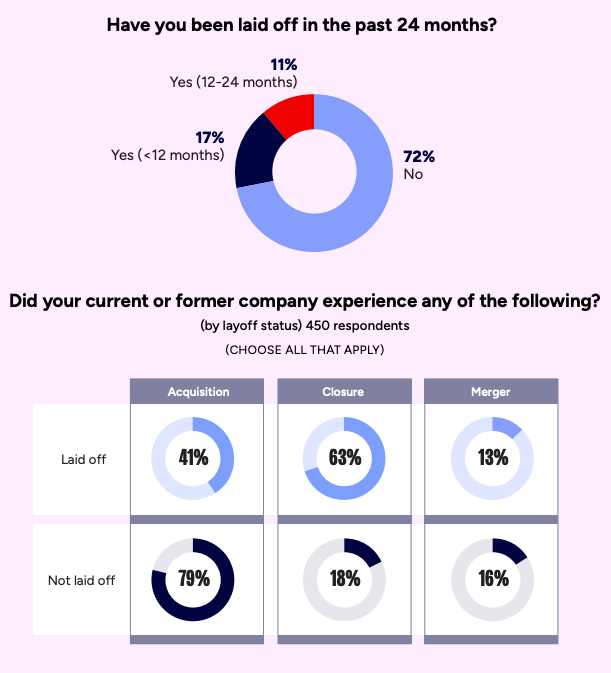
Layoffs depend heavily on individual company circumstances. In the screenshot above, the overwhelming majority of the polled data comes from companies closing or being acquired by a parent company. It’s not shocking: when a company fails, people tend to lose jobs. Why they fail is a different question altogether.
AAA studios are not immune to similar layoffs, despite their reputation for greater financial stability. This same report claims that two-thirds of individuals representing AAA studios experienced layoffs in 2025. However, AAA studios claim this is due to “restructuring” and does not affect the overall quality of their products, while indie developers don’t get that luxury. What’s clear to me from this data is that the larger companies didn’t properly quantify how long the COVID gaming boom would last. It is a matter of opinion, but it’s a fair critique to call this layoff issue “mismanagement,” at least regarding AAA studios. When you onboard thousands of people during a boom, you should plan for potential downturns. The unfortunate thing about these layoffs, in my opinion, is that this report claimed that the highest percentage of layoffs within companies were game designers, including narrative design. I’ve been outspoken about companies focusing on demographics and sales rather than the games themselves. I don’t understand what’s so difficult to grasp. If you make a good game, people will play it.
Another fair question is whether or not the financials justify most layoffs. Activision, for example, had global layoffs within the past 12 months and, in the same period, recorded consistent quarterly earnings growth. To play devil’s advocate for big corporations, despite growth, they may be looking at the long term to avoid the aforementioned mismanagement. It has gotten dramatically more expensive to make games. AAA games cost 150 to 200 million dollars back in 2016-2017, while today games are guaranteed to cost more than double that—in conjunction with the bigger demand to produce constant content within a game to keep it alive. We, as gamers, haven’t made it easy for AAA and indie developers to make big paydays. I know gamers love to complain about how much games cost today, but the reality is that the cost of a brand-new title has changed only marginally compared to the increase in game production costs. Throughout my teen years in the 20’teens, a new game was $60; today, a new game from a AAA corporation is $70. Yes, microtransactions are in every game today, but games are not even close to increasing in cost to the consumer in proportion to their production cost.
Despite my best efforts, I can’t find a concrete example of real nefariousness at play. I think we all are in a pickle when it comes to the golden age we live in. Corporations have to spend more to make more, and consumers get bored too easily for anyone to really win in a transaction. The other brutal truth is that other industries drive many of these problems. Game developers have to compete with the average consumer spending several hours a day doomscrolling as their preferred entertainment, and consumers have to deal with everything getting more expensive, not just their games. The layoffs are unfortunate, but you can’t look at any other tech space today and not see similar trends.
With AI getting better and better, the harshest truth is that people in charge of remedial, non-creative tasks are going to lose work. When the printing press was invented, everyone employed to copy books by hand lost their jobs. As in every era in human history, people have needed to adapt, and I don’t see the new industrial revolution we are in as any different.