


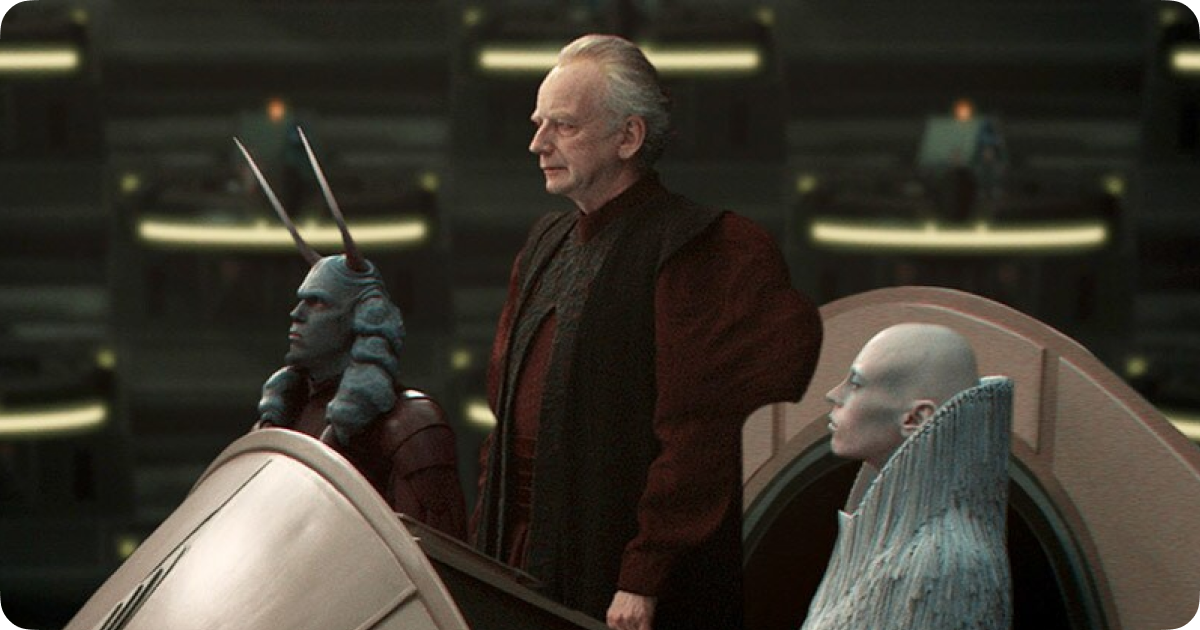
The Star Wars Prequel Trilogy has a divisive history. Over time, I think most Star Wars fans have come to love the prequels. A really sweet moment that affirmed this love was the standing ovation Hayden Christensen received while at Star Wars Celebration London in 2023, after his reprisal of Darth Vader for the Obi-Wan series. We love the visuals of the lightsaber battles those three films created, and we love to hate (except for Tyler) the ridiculousness of characters such as Jar Jar. Yes, the prequels aren’t perfect, but as someone who grew up in a family that loved intellectual challenge and debate on all possible topics, I love the prequels for the overlooked political conspiracies deep within the narrative. For those who thought this was boring or didn’t really pay attention to the fine details, Emperor Palpatine’s rise to control an intergalactic empire is one of the most prophetic stories ever written, in my opinion.
In Episode I, Senator Palpatine represents the planet Naboo in the Galactic Senate. Behind closed doors, later to be revealed in Episode III, we learn that Palpatine is Darth Sidious, the dark lord of the Sith, creating all of this planetary conflict. However, the details of this all-time great rise to power are tragically fascinating.
Back in Episode I, Darth Sidious approaches the Trade Federation and convinces its leader, Nute Gunray, to form a blockade around the planet Naboo, followed by a planetary invasion. The pretext to this move is create a trade conflict for the Galactic Senate. Nute Gunray’s objective is to imprison Naboo’s Queen Amidala to force her to sign a peace treaty that would make the invasion legal within the Galactic Senate. Jedi Qui-Gon Jinn and Obi-Wan Kenobi foil this plot, free the Queen, and expose the influence of a Sith Lord. However, Palpatine uses Queen Amidala’s testimony to push a vote of no confidence against the current Chancellor of the Republic. This allowed Palpatine to be elected Chancellor of the Republic and leader of the Galactic Senate, which was his plan all along.
“Enter the bureaucrats—the true rulers of the Republic. And on the payroll of the Trade Federation, I might add. This is where Chancellor Valorum’s strength will disappear.” —Senator Palpatine
After these events, off-screen, with the Trade Federation’s illegal invasion exposed, Nute Gunray, under the command of Darth Sidious, secedes from the Galactic Republic to form the Confederacy of Independent Systems, also known as the Separatists. Count Dooku, former Jedi turned Sith Lord by Palpatine, is the leader of the Separatists and goes around the galaxy to convince other star systems to leave the Republic, which they do. Entering Episode II, the Separatists’ numbers are growing, primarily made up of planets responsible for labor, banking, galactic exports, all things needed for economic consistency and flexibility. Some of these are within the Separatist Alliance in secret and still hold authority within the Galactic Senate to manipulate politicians, such as the Techno Union. The Techno Union is responsible for the Separatists’ Battle Droid Army and can build it up without the Senate or the Jedi knowing.
In Episode II, the Separatists create conflict across Republic Star Systems to spread the Jedi thin, preventing them from controlling the rapid secessions from the Republic. The very opening scene is a Separatists funded terrorist attack on now Senator Amidala (the former Queen of Naboo). With these increasing terrorist attacks across the galaxy, the Jedi and Chancellor Palpatine are left with the question of how to keep the Republic safe from such terrorism. Later in the film, Obi-Wan Kenobi is tasked with finding the party responsible for the attack on Senator Amidala. On this mission, Obi-Wan finds the bounty hunter hired for the attack, learns about the creation of the Separatists’ Droid Army, and discovers that Count Dooku leads the Separatist Alliance. More importantly, he discovers the creation of a Clone Army on the planet Kamino, allegedly commissioned for the Galactic Senate by Jedi Master Sifo-Dyas (who is deceased at the time of this discovery). The Jedi and Senate claim they don’t know about the Clone Army, and that becomes very important later.
Obi-Wan is then captured, which compels Jedi Anakin Skywalker and Senator Amidala to rescue him, resulting in their capture as well. With the newfound discovery of the Separatists’ Droid Army, it becomes clear to the Jedi and Chancellor Palpatine that the Jedi alone cannot combat this threat, and that the Republic needs to create an army. The issue is, the creation of such an army is illegal without a majority vote of the Senate, a vote that would be gridlocked in ideological debate, like most controversial political actions within a democracy usually are. Before Senator Amidala was capture she left her legislative powers to a fellow representative of Naboo, Jar Jar Binks. Jar Jar and the rest of the Jedi Council are swayed by one of Chancellor Palpatine’s minions to propose granting the Chancellor emergency war powers to bypass the Senate and form a Republic Army. Jar Jar creates the proposal; it passes, and the Clone Army of the Republic is formed.
“It is with great reluctance that I have agreed to this calling. I love democracy. I love the Republic. Once this crisis has abated, I will lay down the powers you have given me!” —Chancellor Palpatine
With the army created, the Republic launches its invasion on the Planet Geonosis to rescue Obi-Wan, Anakin, and Senator Amidala, and to capture Count Dooku. Dooku’s capture fails, and the Clone Wars officially begin. While all this is happening, Palpatine gains complete war time control of the Republic, control over the Separatists, and grooming the chosen one (Anakin Skywalker), to inevitably bring down the Jedi and have the Sith rule the galaxy.
Finally, in Episode III, the Clone Wars are in full swing. Palpatine orchestrates an attack on the Republic Capital, Coruscant, and Count Dooku captures him. Palpatine uses this capture to have Dooku, his Sith apprentice, killed by Anakin Skywalker to push Anakin further down the path of the Dark Side. Earlier I mentioned the Clone Army’s origins. Master Sifo-Dyas did, in fact, commission the armies’ creation in secret from the Jedi; however, he intended for the Republic to control the army for its own welfare and preservation. Darth Sidious discovered this army’s creation and had Count Dooku assume Master Sifo-Dyas’s identity to steal the army for the Sith’s benefit. The animated series Star Wars: The Clone Wars reveals that Palpatine had chips implanted in the clones’ brains to hijack their loyalty when an order is given. Order 66.
With Dooku now dead, and Palpatine’s final plans in motion, he orders the remaining leaders of the Separatist Alliance to flee to the planet Mustafar and await further instructions. The Jedi begin to sense the Dark Side of the Force surrounding the Chancellor and fear that he will refuse to let go of his emergency powers, powers that allowed him to stay in the position of Chancellor far past his term. Anakin, groomed by Palpatine throughout his life, reluctantly tells the Jedi that Palpatine has revealed himself as Darth Sidious, the mastermind behind the war all along. The Jedi then go to arrest Palpatine and fail because of his power in the Dark Side and his connection to Anakin. Anakin pledges his allegiance to Darth Sidious and henceforth is known as Darth Vader. This is where Order 66 is executed, the Jedi fall, and Palpatine forms the Galactic Empire, declaring himself Emperor.
“So this is how liberty dies... with thunderous applause.” —Padmé Amidala
As you can see, you can overlook a lot of details if you’re not a die-hard Star Wars fan. I am just as much a fan of this franchise as I am of politics, history, and current events. George Lucas used political undertones to shape the story of Darth Vader’s creation. Lucas once said in an interview with Time Magazine in 2002:
“All democracies turn into dictatorships, but not by coup. The people give their democracy to a dictator, whether it’s Julius Caesar or Napoleon or Adolf Hitler. Ultimately, the general population goes along with the idea…What kinds of things push people and institutions in this direction?”
Lucas firmly believed that true corruption isn’t achieved through brute force alone, but through a scared people willing to forfeit freedom for security. Sound too familiar? While my views were not shaped by the times of George Lucas, such as the Vietnam War, as a 27-year-old, I have lived and seen the creep of totalitarianism that Lucas masterfully brought to life in this trilogy. Let’s look at some examples from our time.
September 11th, 2001 is one of, if not the most impactful, singular events in modern American history. While I am too young to remember such a tragedy, I’ve lived in an American culture shaped by its outcomes. We were told that Osama bin Laden attacked America purely for his hatred of our freedoms and radical beliefs found within his faith. While this may be partially true, it does not tell the full truth. In his most recent presidential bid, President Trump campaigned to release a multitude of classified government documents to the public. Ranging from the assassinations of MLK, JFK, the Jeffrey Epstein Case, and the events that took place on 9/11. This was such an important issue for people who voted for him because the unfortunate truth is, long-mocked conspiracy theorists were starting to be proven right in isolated details of the aforementioned events and scandals. Full transparency, I love conspiracy theories, and it is fair to at least say there are more than a few questions surrounding events like these. People across the political spectrum want transparency. 9/11 is a perfect example.
The official narrative of the terror attacks on New York and Washington D.C has marginally changed over the years but the overall message has been the same. Across the United States’ major intelligence agencies, bits and pieces of the potential threat were apparent and being monitored; however, because these agencies did not share their intelligence, the proper authorities could not reduce or even prevent the attack. It was the largest intelligence blunder in American law enforcement history. The CIA was monitoring all of the 19 hijackers before the attack. As early as January 2000 two highjackers specifically Khalid al-Mihdhar and Nawaf al-Hazmi arrived in Southern California legally using B-1/B-2 multiple-entry tourist/business visas issued by United States Consulate in Jeddah, Saudi Arabia. 13 other hijackers received passports from Saudi Arabia, 2 from the United Arab Emirates, 1 from Egypt, and 1 man from Lebanon. The mastermind behind this attack, Osama bin Laden, communicated to only a few of the leading hijackers through, courier, internet messages, telephone calls in the couple of years before the attack was initiated. For over a year, the CIA was monitoring all of the hijackers living within the United States without putting them on any official watchlist for any other intelligence agency to monitor. The first time any other agency was made aware of any hijackers was in late August of 2001, when the CIA informed the FBI to put Khalid al-Mihdhar and Nawaf al-Hazmi on the official terror watch list. By then, not enough information was shared with the proper authorities, and the attack was not prevented. Intel was gathered, that intel has failed to be dispersed, and because of that failure anti freedom terrorist killed almost 3000 people.
The overlooked reality is that this tragedy could have been prevented. Outside influences had plans for a Middle Eastern conflict, as well as expanded government control within the United States. Those influences used this tragedy to achieve those plans. With the passage of the Patriot Act in October 2001, mass surveillance of American citizens became permitted and easier by lowering the judicial thresholds of the FISA Court (Foreign Intelligence Surveillance Court). This court is essentially a secret court that permits intelligence agencies to accomplish things like mass data collection and wiretapping on American citizens without obtaining a warrant, therefore bypassing your 4th amendment rights. All this is done in the name of preventing terrorism. Edward Snowden famously exposed this mass data-collection scandal in June 2013 and proved that leaders within intelligence agencies committed perjury in congressional testimony to hide it. In March 2013, Senator Ron Wyden asked Director of National Intelligence James Clapper in a congressional hearing, point blank, “Does the NSA collect any type of data at all on millions, or hundreds of millions of Americans?” Clapper’s response: “No, sir.” Despite Clapper committing perjury on national television, he was never charged or further investigated; however, Edward Snowden has not been on U.S. soil since 2013 and has been charged under the Espionage Act of 1917, preventing his return.
It’s also clear that politicians within the U.S. government, as well as other foreign interests, have wanted U.S. involvement in Middle Eastern conflicts. Our involvement goes back to 1979 with the Soviet Union’s invasion of Afghanistan. The CIA used black budget funding in an Operation Cyclone to build up, train, and fund Afgan efforts against the Soviet Union. One of the organizations that received such funding through the CIA is the Maktab al-Khidamat also known as the Afghan Services Bureau, which was an organization founded in 1984 by Abdullah Azzam and Osama bin Laden to recruit, fund, and logistically support Arab volunteers fighting against the Soviet occupation of Afghanistan. The Mujahideen (voluntary afghan soldiers) also received funding from the CIA and also was a logistically and financially led by bin Laden. Despite multiple financial ties to our own intelligence agencies and the most famous terrorist in U.S history, the CIA has denied any known relationship with bin Laden over the decades of the Soviet-Afghan conflict. While it may be true that there was no official relationship, by the CIA’s own admission, surveillance of bin Laden as a potential terrorist threat began in 1996, just 4 years after Operation Cyclone ended in 1992.
Continuing the trend of interests wanting Middle Eastern conflict, you can find a handful of individuals with a long history before 9/11 of pursuing this goal. You can look any Prime Minister of Israel since the countries inception in 1948 lobbying the invasion of specifically Iran to the U.S and other allies. Benjamin Netanyahu (Israeli Prime Minister) testified to congress three times within 1 year after the events on September 11th urging for U.S involvement to combat terrorism, as well as overthrowing Saddam Hussein and Yasser Arafat, individuals who had nothing to do with the 9/11 attacks. Paul Wolfowitz, a career politician and Deputy Secretary of Defense from 2001 to 2005, played a major role in creating two plans within the Pentagon. The first is known as “The Clean Break Memo” which was a plan detailing a plan to abandon the Oslo Accords (temporary peace treaty between Israel and the Palestinian Authority) for a proactive, militarized strategy to ensure Israel’s regional dominance. The document mentions that to convince the United States to get involved, there would need to be “a catastrophic and catalyzing event” to sway U.S. action. The second document, which was exposed in 2007, detailed the United States war plan for the war on terror. This plan, called the “7 countries in 5 years” memo, detailed the 7 countries the United States military would overthrow within 5 years. The countries are: Iraq, Syria, Lebanon, Libya, Somalia, Sudan, Iran. The United States has taken military action against all of them. Both of these plans share some of the same creators, one of whom is Paul Wolfowitz.
History is just as rich, controversial, and enticing as stories told a long time ago in a galaxy far, far away. We should do more to appreciate those who put their efforts in storytelling to reveal unfortunate truths within our own societies, and nature. We hate to think that there is an evil influence that can manipulate our governments and our people, but in reality it all all tyranny is gladly handed over in the modern age. Everything I have detailed is easily verifiable, and I did my absolute best to leave out more controversial details that have a more circumstantial basis. Lucas was never truly appreciated for the larger story he was trying to tell, so I implore everyone to make sure you know the facts of history instead of learning from institutions and authorities that have repeatedly manipulated you.